Back
Back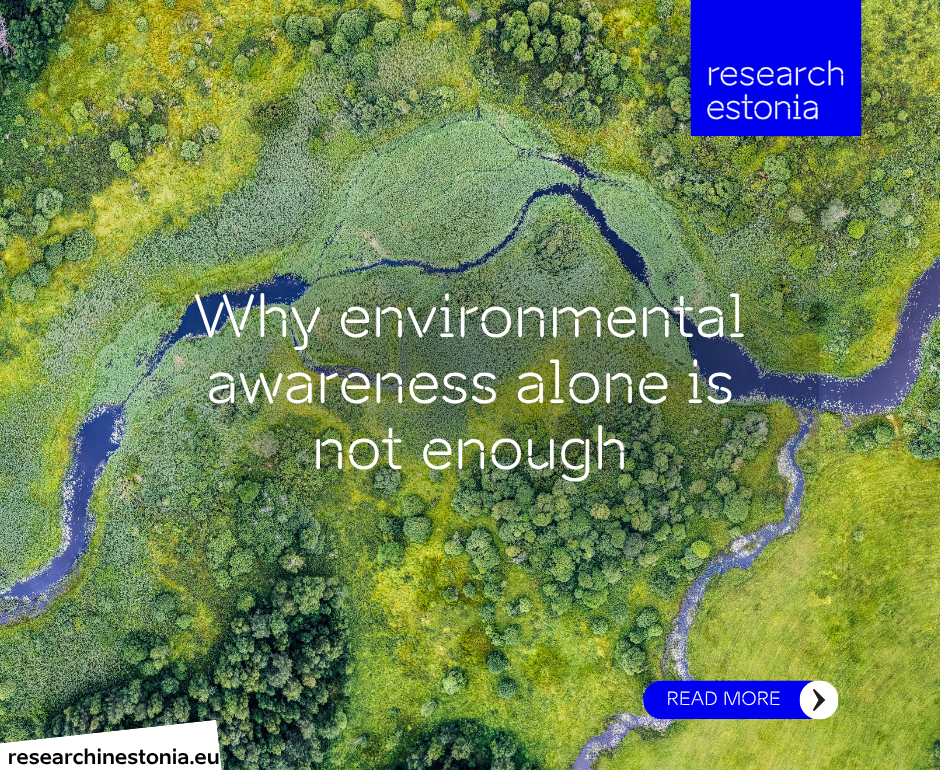
A research group formed to advocate for interdisciplinary research is tackling environmental issues and climate change through unique and creative ways. One of the group’s goals is to highlight that awareness alone is not enough – if people truly understand environmental issues, this understanding should be reflected in their actions.
The research group, called SEEMIK, or Research Group for Sustainability, Environmental Education and Communication Skills, brings together specialists in ecology, education, psychology, anthropology, digital technologies and communication. SEEMIK is tackling climate change on multiple fronts, by contributing to microdegrees at universities and conducting various projects with pupils from all levels of education.
The members of the research group agree that their strength is in fact the interdisciplinary approach, as their main goal is to find practical solutions to climate change and environmental issues. SEEMIK’s educational psychologist Grete Arro states, “We were all concerned about certain environmental issues and wanted to do something, yet realized that it cannot be done alone, as everyone only sees things from their point of view or from their scientific field.’’ The group’s ecologist, Jaanus Terasmaa, emphasises that the primary goal of the group is to have a tangible impact on society. Rather than focusing solely on academic publications, SEEMIK prioritizes projects that reach schools, decision-makers, and make an actual impact.
The main aim of the research group’s work is to create a resilient society, aware of how the environment works as a system. Awareness means acting on what you know, as Arro suggests, if one truly understands something like climate change, their choices will reflect it and if the choices don’t, they don’t fully grasp it. Arro also points out that the group works on “raising awareness that if we don’t change, there will be consequences, and these consequences must be brought to the forefront. Everyone talks about how environmentally friendly activities have a price for society, yet no one talks about how much bigger the price is if we don’t act.’’
Awareness just isn’t enough anymore. The group’s anthropologist Aet Annist and ecologist Jaanus Terasmaa with Piia Post (not presently part of SEEMIK) recently wrote an article in the Human Development Report which essentially highlights how awareness and behaviour do not go hand in hand as people with higher education are very aware of climate issues, but that does not mean they behave accordingly. Aet Annist stresses that SEEMIK’s work also draws on psychology and anthropology to better understand how to encourage meaningful changes in people’s habits and ways of thinking.
A recently ended project, AI-Powered Education for Active Learning Through Participation, took place in Estonian and German schools and included secondary school students. The project was based on an AI-powered chatbot with different characters such as a cynical scientist, a psychologist, a future scientist that has already solved climate issues, and so on. The chatbot presents a scenario involving a problem that must be solved. SEEMIK’s educational scientist Triinu Jesmin emphasises that the project aims to solve the lack of optimism regarding climate issues and the sense of hopelessness within the youth. After interacting with the chatbot, students became more aware of the impact an individual has on the climate. As a result of the project the students also believed that meaningful action is possible.
Another recently completed project, BuildAsNature, is a game for university students aiming to develop students’ ability to become future problem-solvers, supported by nature-based solutions. Instead of pipes and sewer systems for handling floods in urban areas, let there be more green spaces.
A project called SHINE, which is set to conclude in 2026, tackles climate change through the lens of systems thinking with 8–16-year olds. Systems thinking means understanding how independent parts make up a whole – a crucial skill regarding the environment and climate change. Grete Arro suggests this type of thinking may lead people to become accustomed to applying the precautionary principle – one starts to understand the consequences of their actions.
SEEMIK’s work doesn’t only address students, as Arro notes that the research group’s work recognizes the unfairness of placing the responsibility for environmental issues and climate change on the youth, as it should rest with decision-makers who must address these challenges. Arro stresses that if we want actual change, we must tackle every piece of the puzzle, every part of the system that constitutes the whole.
This article is written by Annette Maria Hermaküla. This article was funded by the European Regional Development Fund through Estonian Research Council.
If SEEMIK shows why environmental awareness must grow into action, University of Tartu researchers approach the sustainability puzzle from the molecular level: Theoretical framework developed by University of Tartu researchers creates new opportunities for clean energy production.