Back
Back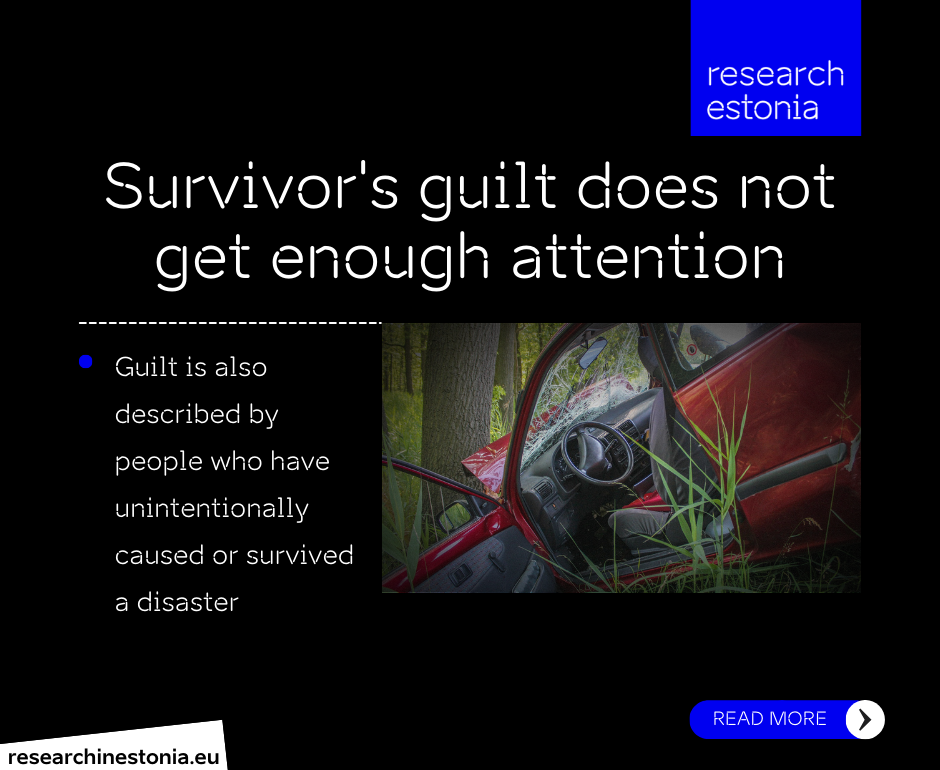
Table of Contents
Traditionally, one speaks of guilt when a person is morally wrong. Guilt is also described by people who have unintentionally caused or survived a disaster. The doctoral thesis defended at the University of Tartu shows that this type of guilt deserves to be understood and is felt as a moral sadness for having contributed to a bad situation.
“If we look at how the concept of guilt is used in practice, we see that people talk about guilt even if they accidentally caused a car accident or left someone behind, for example,” explains Heidy Meriste, a lecturer at the Institute of Philosophy and Semiotics at the University of Tartu. “In these situations, people may not think they are morally wrong, yet they still feel guilty.” People who survived disasters while others didn’t talk about their guilt in the same way.
According to Meriste, the traditional approach to guilt places emphasis on blame, where a person has done something morally wrong. By contrast, the guilt of those who caused or survived an accident may not always be understood by those around them. In her recently defended doctoral thesis, Meriste therefore proposes a benefit-based approach to guilt, where the emphasis is not so much on the person as on the world around them. “I’m not talking about a person feeling morally stained,” she says. “Rather, the problem is how they feel they have made a stain on the world.”
Where is the guilt in this situation?
In her doctoral thesis, Heidy Meriste focused on two types of guilt scenarios. The first of these are causal situations, i.e. situations where harm is caused: for example, a car accident where the person is at the wheel. “There’s really nothing that could have been done differently,” she explains. “It just happened so fast.” Likewise, one person can cause heartache for another if they are not equally in love with them. “We don’t think we necessarily have a moral obligation to respond to the feelings of just anybody,” Meriste argues. “Yet people feel guilty.”
Secondly, she described cases of so-called ‘survivor’s guilt’, in which a person may be the only survivor of a disaster. But more generally, it can be about perceptions of unfair privilege. “For example, an inheritance is left to two children,” she describes. “Both have been good children to their parents, but one will receive a much bigger share of the inheritance than the other.” People may also feel, for example, a sense of social injustice that they have a good life, while elsewhere in the world locals are suffering from hunger.
“It is very common in folk psychological discourse to talk about guilt in these situations too,” says Meriste, formulating the central concern of her thesis. “The question is, how do we talk about guilt when there is no wrongdoing?”
Right here, she proposes a solution herself. In the situation described, one should not look so much for moral wrongdoing as see whether the person has in some way contributed to a bad situation. In the philosophical sense, according to Meriste, we can speak here of a “counterfactual relationship”. “This contribution suggests that one person can make a difference in the world,” she explains. “If they hadn’t made some specific contribution, things would be better somehow.”
In the case of causal guilt, a person’s contribution to a bad situation acts as a simple causal link. “If you hadn’t been driving on that road at that time of day, there would have been no accident,” says Meriste. “Even though it wasn’t your fault, you caused it.”
In cases of survivor’s guilt, one’s contribution lies in the state of things: they are alive, while others are not. According to the fresh doctor, in this case, the person themselves is part of the injustice of the world: “If things had gone differently for me, the situation would be less unfair comparatively.”
“This is now my contribution to the world”
Heidy Meriste proposes a benefit-based approach to blame as a contrast to the traditional blame-based view. She stresses that this is not self-blame based on anger. “Rather, the guilt is perceived as a kind of moral sorrow that this is now their contribution to the world,” she explains. “In a way, they feel they have made the world a worse place.”
In her work, she looked at socio-psychological studies and autobiographical accounts of guilt. A common concern was that people with causal or survivor’s guilt want to tell others that they feel guilty. “However, the response from others is often, ‘But you didn’t do anything wrong’, as if to say that they shouldn’t feel guilty.”
According to Meriste, the “Nothing to talk about here” and “Get on with your life” type answers suggest that the responder does not really understand the essence of benefit-based guilt. “It should be understood that guilt for that person is not a perception that they did something wrong, but a tragic perception of their impact on the world,” she suggests. However, a person’s impact on the world is not always intentional, as they also influence the world through their presence as a physical body. “For example, miscarriage is far from being the woman’s fault, but it is still linked to her body,” Meriste points out.
It is also worth thinking about deservingness when talking about causal and survivor’s guilt, she says. In other words, a person who feels guilty may perceive that the victim suffered unfairly. “Suppose a lecturer gives a student a bad grade – they may feel sorry for the student, but not feel guilty if the grade doesn’t seem unfair.” The victims of a car crash, on the other hand, did not deserve their fate, according to the person behind the wheel.
Even if there was no moral wrongdoing in the cases Meriste dealt with, people want to make sense of the guilt associated with what happened in moral terms. With the approach she proposes, the fresh doctor gives them that opportunity. “A strong sense that something is morally wrong is reported, but it is not a moral wrongdoing,” she describes. “I would say that it is the situation that is morally bad. The moral element shifts from one place to another in my approach.”
For the causal or survivor guilt-ridden person, her approach also points to a way out of guilt. “Even if you can’t change what happened in the past, you can work towards a better world,” Meriste points out. For example, a person may be in hospital with someone and another patient in the room dies. “In this case, you can raise people’s awareness and do preventive work so that less of this kind of thing happens,” says the fresh doctor.
Author: Airika Harrik. This article was originally published on the the Estonian Public Broadcasting online news portal.
If this article gave your mind something fun to chew on, don’t stop the introspection! Wander over to our next piece and let your curiosity do a little more cognitive cartwheeling, read more about how Loneliness is largely an inner game, study confirms!