Back
Back
Nano- and microplastics are increasingly detected in the human body. However, their detection remains challenging, often relying on invasive techniques and specialized equipment. Researchers at the Institute of Computer Science at the University of Tartu are developing a device that can measure plastic in human body.
Micro- and nanoplastics are everywhere – in the air we breathe, the water we drink, the food we eat, and even in the clothes we wear. Recent studies have found these plastics throughout the human body, even in the bloodstream and almost all internal organs.
Truth is, we don’t really know yet how does this affect our health. The long-term effect of exposure to these plastics is still largely unknown. However, animal and cell studies have shown that microplastics can accumulate in living organisms, spread to various tissues, and promote inflammation, oxidative stress, and metabolic disorders, particularly affecting the digestive and respiratory systems. That’s why we want to measure the microplastic particles in human organism, so we can understand better how much plastic our bodies actually contain, and in the future guide interventions or policies to reduce our exposure to plastics.
Current methods to measure them require taking blood samples. Although they are difficult, expensive, and not something anyone wants to do frequently. We are looking for a way to “see inside” without drawing blood. That is exactly what led us to using light sensors.
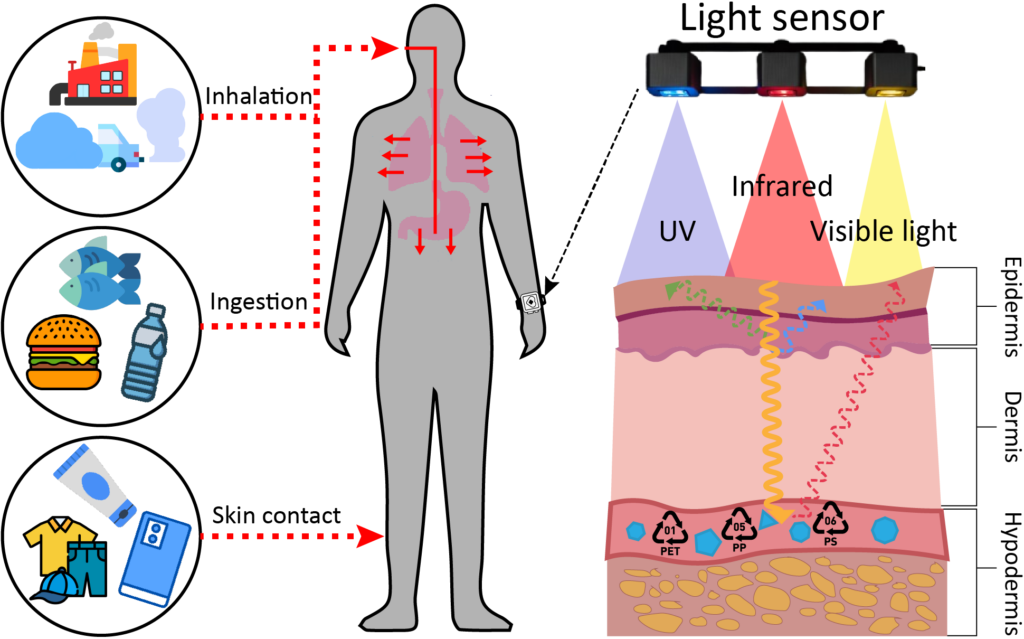
Light-based sensing has already been used to detect plastic particles in many environments, such as in soil and in water. It works because different plastics reflect and absorb light in unique ways, they are like optical patterns that sensors can actually recognize. We’re bringing that same idea into the human body using wearables, like smartwatch, smartring, or smartband.
Our approach uses a miniature spectrometer, essentially a tiny device that shines different colors of light and measures how each one bounces back. It can detect both visible light that we can normally see around us, and wavelengths like near-infrared and ultraviolet, that are invisible to the human eye.
Using this technique, we successfully detected plastic particles embedded beneath the surface of artificial skin we created ourselves. There is still a long way to go to make our vision a reality, but already these results demonstrate the potential of wearable spectrometry. In the near future, wearable devices could enable non-invasive, easily accessible monitoring of microplastics inside the human body.
Demo link: https://www.youtube.com/watch?v=_V8sRMVO8bU
DOI: https://dl.acm.org/doi/10.1145/3789514.3792059
If this look at plastics molded your curiosity, don’t stretch it thin! Shape your next read and learn more about how Exotic salts help to turn domestic wood into plastics and platform chemicals!