Back
Back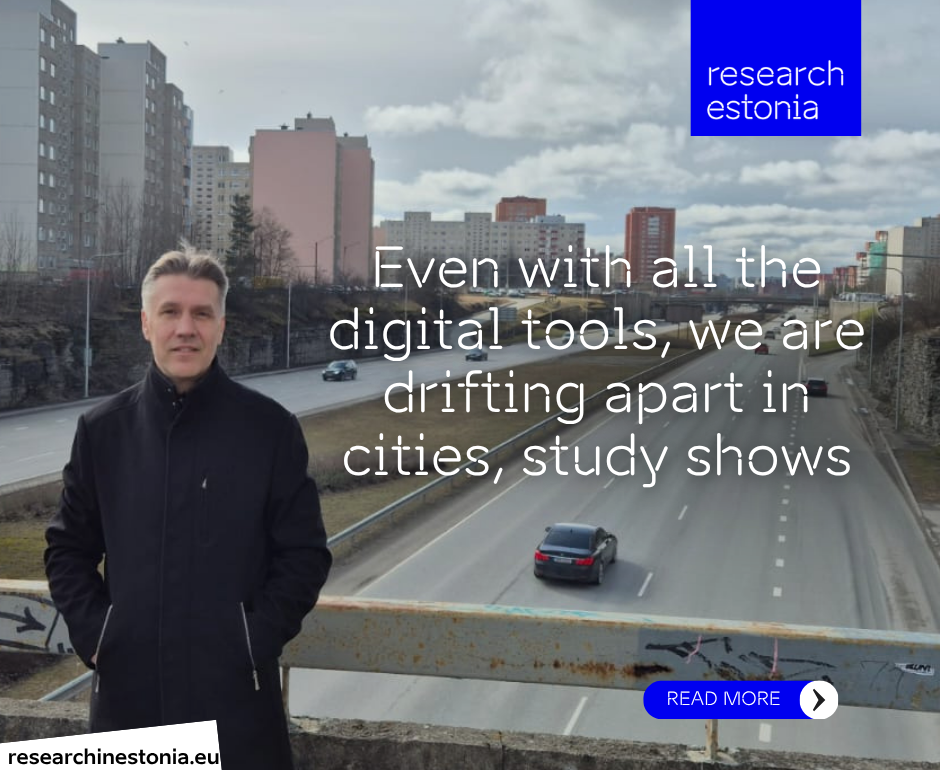
Table of Contents
One of the world’s most digitally advanced cities is also surprisingly segregated, research shows.
“A global leader in digital innovation that unites people,” a National Geographic journalist once described the capital of Estonia, Tallinn. In reality, equal digital opportunities didn’t translate into physical closeness.
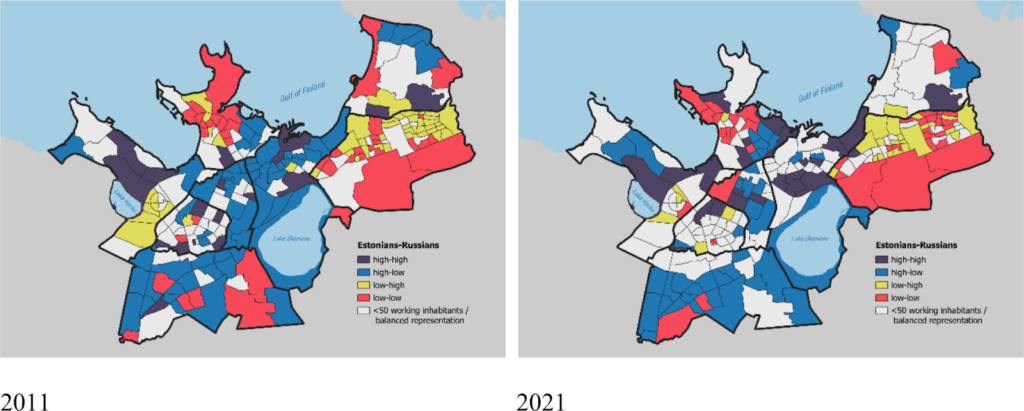
Surprisingly, Tallinn stands out as one of the most segregated cities in Europe. How come?
“People crave familiarity,” explains Tiit Tammaru, Professor of Urban and Population Geography at the University of Tartu. When it comes to moving into a city, humans tend to seek out their own kind. Ukrainian refugees who grew up in a blockhouse end up finding a home in one of the blockhouse districts in Tallinn. Western European immigrants prefer the historical city center. People from the Russian-speaking part of Estonia move to the predominantly Russian-speaking district of Lasnamäe.
People find their own kind. What can be bad in that?
Urban researchers warn that it has a long-term cost.
The 16-City Reality Check
Last year, the results of a massive research project on segregation in European capital city-regions were published in the journal Urban Studies. A team of researchers looked at 16 European cities to see how socio-economic segregation changed from 2001 to 2021.
While Tallinn sits in the “high segregation” cluster, it didn’t take the top spot. “In our study, Paris and Stockholm stand out as the most segregated cases,” says Rūta Ubarevičienė from the Lithuanian Centre for Social Sciences. In those cities, higher- and lower-status groups live more separately, in different parts of the city, with less social mixing between them.
However, Tallinn far outperformed its Baltic neighbors, Riga and Vilnius, in terms of social division. Even though, as Ubarevičienė noted, segregation is not a universal trend. Some cities are actually desegregating now.
When a cleaning lady lived next to a director
To understand why Tallinn is so divided today, we have to take a look at Estonian history. Tammaru and other scientists have also analysed segregation 30 years ago. Due to the Estonian communist past, Tallinn was not so divided by income.
“In the Soviet era, it was common that a director and a cleaning lady got the apartment in the same house,” says Tammaru. Incomes in general were lower and didn’t create huge gaps between different social groups.
Segregation by nationality started during the Soviet era. Tallinn was growing fast due to immigration from other parts of the former Soviet Union. Whole districts were built to accommodate newcomers, and Russian-language schools were opened. Tammaru explained that in a way, it saved the Estonian language that only about a million people speak. “That’s the reason why we still had schools in the Estonian language,” he added. While in other parts of the Soviet Union, Russian language took over whole societies, that didn’t happen in Estonia.
The “vacuum cleaner” effect
The real shift occurred after the restoration of independence in the 1990s. While Estonia saw very fast economic growth, the physical cityscape didn’t reflect this new wealth until around the 2000s. “We reached quite quickly into a very segregated city,” says Tammaru. As soon as the new developments started to pop up in different places in Tallinn, they started to attract higher-income people. “It’s a vacuum cleaner effect. It sucks the richer people away from other neighbourhoods,” said Tammaru.
Ethnic barriers are falling, class barriers hardening
A recently published study in Nature Cities shows that the digital transition is acting as a double-edged sword. The tech sector has createed a new class of highly mobile, highly paid professionals who have the freedom to choose where they live. Minority tech workers are increasingly clustering in large cities and contributing to ethnic desegregation by moving into majority neighborhoods.
Essentially, the “winners” of the digital transition (those with high-paying ICT jobs) are using their financial freedom to integrate ethnically. However, this comes at a cost to those left behind. The spatial isolation of non-tech minority workers, particularly those in lower-status occupations, becomes more pronounced. Ethnic barriers might be falling for the elite, but class barriers are hardening for everyone else.
The study also reveals a fascinating difference between native-born and foreign-born minorities. Newly arrived “global talent” in the tech sector tends to seek quality of life in amenity-rich, majority-group neighborhoods from the start. In contrast, native-born minorities often maintain a stronger attachment to the ethnic infrastructure, the schools, cultural institutions, and communities, where they grew up.
Solutions for a cohesive future
According to the researchers, the solutions must be multi-layered. One option is to increase incomes generally, as “increasing the income is one way to change already existing patterns,” concluded Tammaru. Higher income grants the freedom to choose locations based on lifestyle rather than necessity.
Another solution is to make poorer neighbourhoods more attractive. Regarding districts like Lasnamäe, Tammaru notes that the neighbourhood could soon be considered a city centre given its location. The key is renovation, in Tammaru’s view: “The location is good, the apartments are spacious, but the houses are not attractive. So as long as the wallet allows, young people will still choose a newer house.”
Ubarevičienė also pointed out that even if higher-income groups moving into lower-income areas can create mixed neighborhoods, it is often a temporary fix. “Because if housing prices then rise and lower-income residents are pushed out, segregation returns in a new form,” she warned.
That’s why, a more long-term solution would be to offer affordable housing in attractive areas, create mixed-income housing policies, and give equal access to good schools and services across the city.
Ultimately, the goal is to prevent inequality from being passed down through the generations. “If these groups are on their own then the difference starts to reproduce inequality,” says Tammaru. “When children grow up in a low-income district, they communicate only with children with similar backgrounds, go to school with similar children and end up with maybe lower-income positions, without other examples to follow.”
While living in a digitally advanced society offers equal opportunities in theory, we cannot forget how the physical space changes our lives. It might be comfortable to stick to the familiar, but in the long run, the world becomes smaller and more closed off for everyone.
This article is written by Marian Männi. This article was funded by the European Regional Development Fund through Estonian Research Council.
From streets to systems, cities never sit still! Read on to see how The majority of disaster risk management is done during times of stability!