Back
Back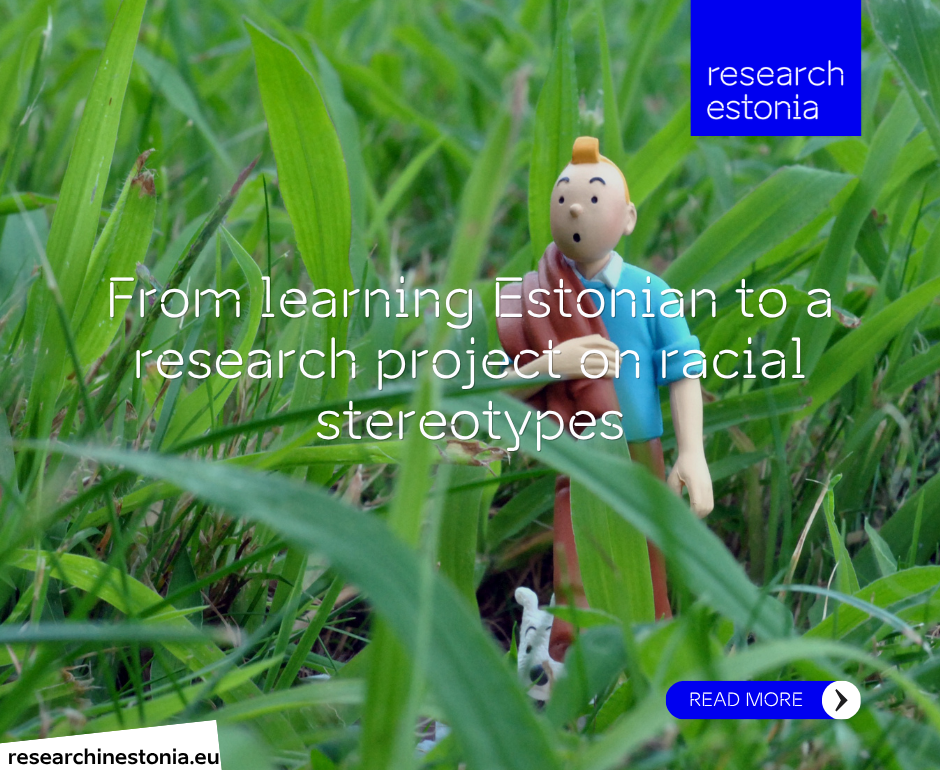
When Nícollas Cayann began studying Estonian culture, he did not expect to end up researching colonial stereotypes. But a visit to a Gori exhibition at KUMU and a closer look at Tintin comics in Estonian raised many questions. Why did people of colour appear so differently from everyone else? And why were the same visual traits repeated across artworks that were created decades apart? Those questions eventually grew into a research project.
Nícollas Cayann, a postdoctoral researcher at the Institute of Humanities at Tallinn University, first became interested in the subject after visiting an exhibition of the renowned Estonian caricaturist Gori’s exhibition in KUMU. There, he noticed that every time there was a person of colour in Gori’s work, they were depicted in a certain way. In a way which has been used since the beginning of colonial times – using visual features such as spooky eyes, big lips, and a pitch-black skin tone.
While studying Estonian language and culture, he noticed something surprising in Tintin comics in Estonian. Unlike some English-language editions, where POC characters’ accents are seen in the spelling of their dialogue, the Estonian translations leave their speech in standard Estonian. The Estonian translator chose to maintain the same register of speech for all characters. This differs from certain English editions, where non-white characters are often portrayed through altered spelling intended to signal an accent.
In an attempt to figure out the roots of this, Cayann started researching both Gori’s work and Hergé’s Tintin comics. What started out as an attempt to study Estonian culture eventually developed into a scientific project.
Additionally, all of the other characters in the caricatures and comics have depth and a variety of expression. Yet characters of colour all look the same and speak the same. And this can be said for centuries’ worth of artwork, both in the written and picture form. Gori’s specialty was caricature, so white characters also have cartoonish features, ridiculously big noses or small noses, etc. However, there was variety in how the white people were made cartoon-like and POCs. Again, all the POCs looked the same.
But Cayann has also studied written representations. In English and French versions of the Tintin comics, Black characters’ written word has been altered, as though speaking in an accent. Cayann brings out how this is only true for the characters of colour even though English has many strong accents, such as Scottish and Welsh accents. For Cayann, this has been done so to make them seem other or lesser than.
Cayann thinks that this is also because these artists or writers had never seen a person of colour in their life and used the images that came from museums, colonial adventures, other artists’ work, which all had the same characteristics – spooky eyes and cartoonishly big lips. However, a Latvian book from 1926, depicting tales from Africa, had beautiful illustrations of people of colour. There were no spooky eyes or big red lips.
The difference? The Latvian artist travelled to Africa. He did not build his book from other artists’ depictions but went there himself. But the other artists, such as Gori, or the writer Hergé, probably never went to these distant places, Cayann emphasises. They simply used other artists’ depictions of people of colour and this is why their characters look like aliens.
This is problematic, as these depictions in museums, caricatures and elsewhere are based on stereotypes that were historically used to dehumanise and discriminate against POCs. Yet many people grew up reading such comics. Cayann argues that these representations shape how readers see the world. If the museums you visit, the books you read, and the cartoons you watch consistently portray a certain group of people in the same way, those images can become your first impression of that group.
For this reason, Cayann does not believe that problematic historical works should simply be removed, but argues that they should be presented with appropriate context and critical commentary. He brings out Hitler’s Mein Kampf as an example. While some scholars believe the book should not be translated or republished, others argue that it remains an important historical artefact that can be studied critically. Cayann says that such history should neither be erased nor celebrated – historical works should be preserved and accompanied by scholarly explanations that help audiences understand the context in which they were created and the ideas they helped to spread.
This article is written by Annette Maria Hermaküla. This article was funded by the European Regional Development Fund through Estonian Research Council.
Stereotypes show how inherited images can preserve old hierarchies, while classical myths reveal how cultural forms absorb each era’s intellectual anxieties: The Faust legend lives on in contemporary literature.