Back
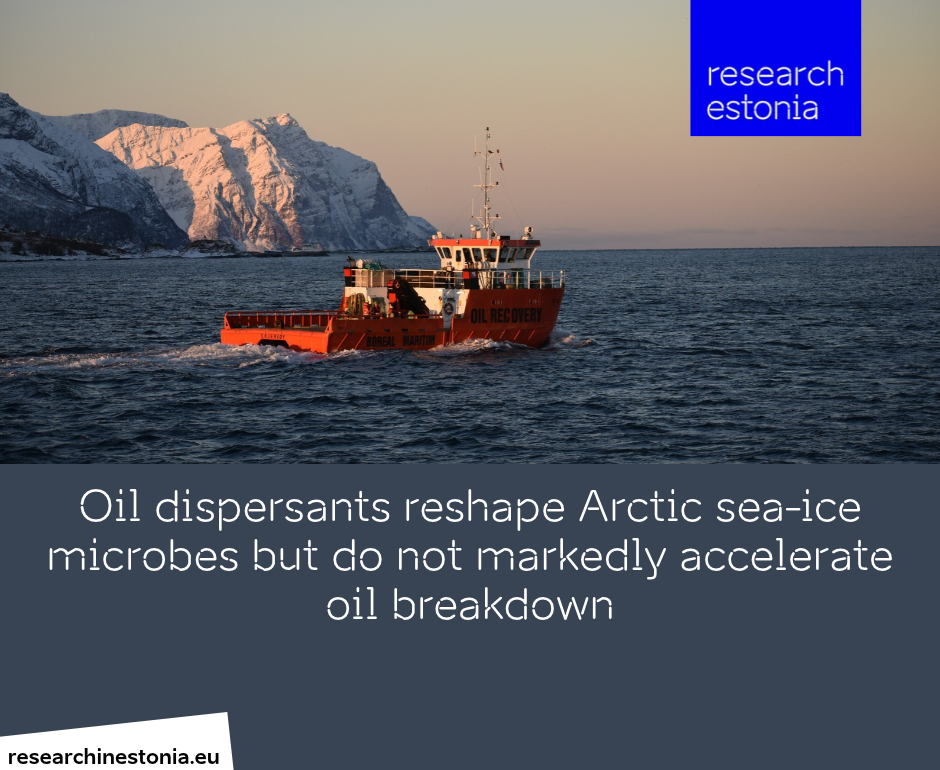
By making the Arctic less ice-covered, climate warming has increased both shipping traffic and the risk of oil spills in the region. Changing ice conditions may, however, affect the effectiveness of currently available oil spill response measures, according to a recent study by researchers from Estonia and Norway.
Sea ice is a challenging habitat for microorganisms. Most microbial cells live in narrow brine channels, where they face sub-zero temperatures, high salinity, oxidative stress, and restricted access to oil compounds. Despite these harsh conditions, a number of bacterial species thrive there, capable of breaking down various petroleum compounds and utilizing them for their metabolic processes.
Oil-degrading bacteria obtain carbon from oil. They also need nitrogen and phosphorus to grow, although these nutrients are very scarce in the waters of the North Atlantic, writes Jaak Truu, a professor of microbiology at the University of Tartu.
Dispersants, compounds that break oil into small droplets, have been introduced as one possible means of combating oil spills at sea. In this way, the oil disperses more quickly in the water column, reducing the direct impact of the spill on marine life and making it easier for microbes to break it down.
Microbial communities are the first to respond
In a three-month study, scientists from a research group at the University of Tartu Institute of Molecular and Cell Biology, in collaboration with colleagues from Norway, analyzed how microbial communities behave in sea ice containing dispersed crude oil or only the dispersant.
During the experiments, cold-adapted bacterial genera, such as Oleispira, Bermanella, and Pseudoalteromonas began to dominate in the ice containing the dispersant. However, these organisms did not all play the same role. Oleispira and Bermanella carried a broad set of genes linked to alkane degradation, whereas the dominant Pseudoalteromonas population had a more limited hydrocarbon-degradation capabilty but extensive traits associated with survival under cold and other environmental stresses.
By analyzing microbial genomes, researchers made an important discovery. It turned out that some of the bacteria studied could produce enzymes that can break down the components of dispersants, including the surface-active agents used to disperse oil. Many of these bacteria had also developed adaptations necessary for withstanding cold and other environmental stress conditions.
Although the dispersant increased the proportion of oil-degrading bacteria, the oil did not begin to degrade faster as a result. The dispersant therefore strongly altered microbial community composition and its genetic functional potential, but it did not clearly increase the efficiency of oil biodegradation under the experimental sea-ice conditions.
The researchers attribute this to the very low abundance of microbes in sea ice, which meant that the microbes that dominated the experiment were primarily those adapted to survive in extreme ice conditions.
Research on sea ice continues
The published results help researchers better understand how Arctic marine ecosystems respond to potential oil spills, and which spill response methods may work best in icy regions. According to the study’s authors, the use of dispersants in sea ice must still be evaluated with caution.
Although these substances rapidly alter the microbial communities in the ice and appear to favor species that degrade oil, it does not automatically mean that the spill will dissipate more quickly.
The study also had its limitations. The experiments were conducted under controlled conditions in laboratory mesocosms – that is, artificial environments designed to mimic sea ice formation. In the real Arctic, in addition to the properties of the ice, the behavior of oil is also influenced by currents, weather, light conditions, and many other factors.
Furthermore, the abundance of microbes in the ice was very low, which may have limited their ability to degrade the oil.
The researchers reported their findings in the journal FEMS Microbes.
This article was sent to us by the University of Tartu.
Oil-spill research cannot stop at the laboratory door; currents also shape pollution’s fate, and following the water is how A Tiny Robot Helps Scientists Understand the Baltic Sea.