Back
Back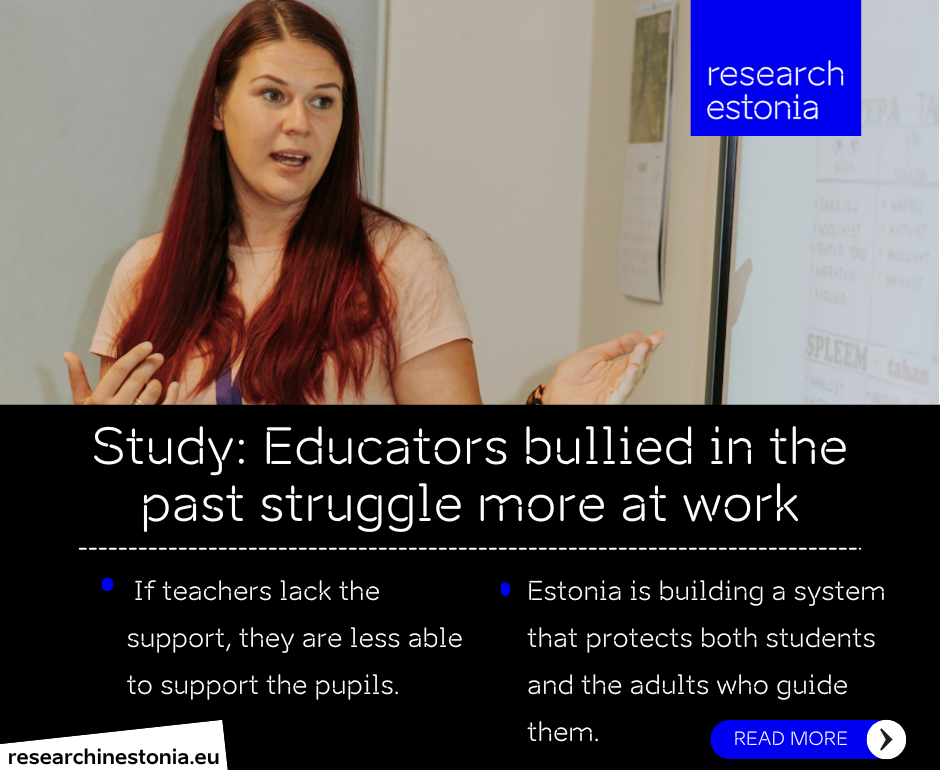
Table of Contents
Most teachers still carry scars from being bullied. It makes it harder for them to do their jobs.
Nobody should have to walk to school or their workplace being afraid of getting hurt. Words can cause just as much pain as fists, and remain for a lifetime.
A Tartu University study looked at what bullying can do in the long run. Not for pupils this time, but for those whose job is to keep classrooms safe: teachers and social pedagogues. In Estonia, social pedagogues work in schools to prevent and address social problems like bullying.
We put a lot of hope and pressure on them. But are they safe? Are we asking “broken” adults to fix broken children?
Estonian researchers, Minni Aia-Utsal and Kristi Kõiv, wanted to find the answers to these questions. They surveyed 446 teachers and 180 social pedagogues across Estonia and found that most, about 74 percent of the teachers and social pedagogues, have had experiences with bullying.
Additionally, 15% of the teachers said they have been bullied at work.
The researchers found that those educators who were bullied in childhood and again later in their professional lives, are paying the highest price. They reported having the least overall life satisfaction and passion for their work.
The findings match the global trend. The 2021/2022 international World Health Organisation report revealed that teacher support is decreasing. Students are reporting that teacher support is dropping internationally across almost all age and gender groups. If teachers lack the support, they are less able to support the pupils themselves.
Hence why we should pay more attention to the teachers’ wellbeing.
Becoming a systemically anti-bullying nation
Even if bullying still exists in Estonian schools, the Baltic nation provides a roadmap for how a country can pivot from having some of the highest bullying rates only 15 years ago to adopting the “Nordic model” of state-level protection. Estonia is now fighting bullying on all fronts and looking at the issue systematically. This research on bullying educators is also a piece of the puzzle. Another puzzle piece is the legislation.
This autumn, a new law became effective in Estonia, obliging all the schools to tackle bullying and design their bullying prevention. It is no longer a nice-to-have for school leadership. It’s now a must.
Estonia’s Ministry of Education is currently renewing the “Bullying-Free Education Concept” (set for 2026), which will serve as the roadmap for the next 5–10 years to fully realize these new legal requirements.
“Not all European countries have this [legal requirement], but this is exactly what characterizes those countries where there is less bullying,” explained Kristiina Treial, a founding member of the Bullying-Free School Foundation in Estonia.
Treial agrees that proper bullying prevention system is a must for protecting the school staff and pupils. Specifically, she emphasises, when things are very well thought through at the political level, “schools can actually design a safe learning environment without bullying.”
But of course, even with the best structures in place, you cannot fix student bullying without protecting the adults.
Estonia is now building a system that protects both students and the adults who guide them. As Treial said, “a teacher who does not feel safe doing their job finds it very difficult to offer a safe learning environment for a child.”
And nothing good comes out of living in fear, especially in a place where the future is created.
Anti-bullying strategies by Estonian researchers:
1. Never force the victim and perpetrator together for a resolution. This can further harm the victim due to the power imbalance.
2. Investigate and document all the incidents in detail.
3. Clearly communicate to the perpetrator that the behaviour is unacceptable.
4. Communicate with the perpetrator with empathy, recognizing they may lack social-emotional skills or means to handle conflict or stress. Focus on teaching them better choices.
5. Encourage bystanders to intervene and communicate that bullying is not tolerated.
6. It’s crucial to follow-up to ensure that the behaviour has ceased and that all parties are recovering.
This article is written by Marian Männi. It was funded by the European Regional Development Fund through Estonian Research Council.
If this story made you think about the education system in Estonia and about teacher-pupil relations, you can find more articles on our website. Check out a story about how to change how students think.